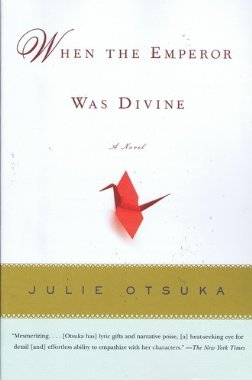
 Title: When the Emperor was Divine
Author: Julie Otsuka
Publication: October 14, 2003
Series or Standalone: Standalone
Paperback or Hardback: Paperback
Acquired: Bought used from Second and Charles
Pages: 144
Rating: 5 stars
Summary:
On a sunny day in Berkeley, California, in 1942, a woman sees a sign in a post office window, returns to her home, and matter-of-factly begins to pack her family's possessions. Like thousands of other Japanese Americans they have been reclassified, virtually overnight, as enemy aliens and are about to be uprooted from their home and sent to a dusty internment camp in the Utah desert.
Title: When the Emperor was Divine
Author: Julie Otsuka
Publication: October 14, 2003
Series or Standalone: Standalone
Paperback or Hardback: Paperback
Acquired: Bought used from Second and Charles
Pages: 144
Rating: 5 stars
Summary:
On a sunny day in Berkeley, California, in 1942, a woman sees a sign in a post office window, returns to her home, and matter-of-factly begins to pack her family's possessions. Like thousands of other Japanese Americans they have been reclassified, virtually overnight, as enemy aliens and are about to be uprooted from their home and sent to a dusty internment camp in the Utah desert.
In this lean and devastatingly evocative first novel, Julie Otsuka tells their story from five flawlessly realized points of view and conveys the exact emotional texture of their experience: the thin-walled barracks and barbed-wire fences, the omnipresent fear and loneliness, the unheralded feats of heroism. When the Emperor Was Divine is a work of enormous power that makes a shameful episode of our history as immediate as today's headlines.
Review:
When the Emperor was Divine is the companion novel to The Buddha in the Attic which was written first and is her debut novel. I decided to be informed on the back story before I read her first book and I stand by this decision.
I have not read any books in the fiction genre that deal with the existence of the internment camps for Japanese Americans so this novel immediately peaked my interest. I was not sure what to expect but I was certainly not disappointed. The most gripping thing about this novel is that the main characters do not have names and all the other minor characters have an identity and are acknowledged by the main characters. This goes along with the theme of the story in which the people who were put in these camps by the U.S. government were stripped of their identity. In order to "prove" that they were not spies they were forced to strip down their heritage and denounce all ties to their family back in Japan.
I loved all of the characters and we get to see a little bit from the point of view of the mother, the sister, the brother, and the father. The father was already in a camp at the beginning of the story so we don't really hear from his point of view for a while except through the letters that he sends to his family. The rest of the family is packing up their house in anticipation of being sent to a different internment camp in the middle of the desert. The two children in the beginning are able to keep up their morale and handle things with that sense of childlike wonder and innocence. They understand that they have to go away from home but they do not understand the full significance of what is going on in the world and in the United States. Overall the book does a great job depicting the fear and hopelessness that the people in these camps felt while they were there. I liked that the story continued on after their release and showed the struggles that the main characters faced when they returned home. People were still not very accepting of them because of their heritage which only added to their sadness and loss of identity. The author also focuses on the family unit which is an element that I love to be included in books. I won't say a whole lot on that subject because I do not want to spoil the book for you.
Overall I absolutely adored this book and I read all of it in one sitting so I know that it was good. I highly recommend this book and I hope to read more by this author and more books on this subject.
Happy Reading!
 Title: Emma
Author: Jane Austen
Published: Sometime in 1815
Series or Standalone: Standalone
Hardback or Paperback: Paperback
Acquired: Bought used from a thrift store
Pages: 474
Rating: 5 stars
Summary:
I never have been in love; it is not my way, or my nature; and I do not think I ever shall.'
Title: Emma
Author: Jane Austen
Published: Sometime in 1815
Series or Standalone: Standalone
Hardback or Paperback: Paperback
Acquired: Bought used from a thrift store
Pages: 474
Rating: 5 stars
Summary:
I never have been in love; it is not my way, or my nature; and I do not think I ever shall.'
Beautiful, clever, rich - and single - Emma Woodhouse is perfectly content with her life and sees no need for either love or marriage. Nothing, however, delights her more than interfering in the romantic lives of others. But when she ignores the warnings of her good friend Mr. Knightley and attempts to arrange a suitable match for her protegee Harriet Smith, her carefully laid plans soon unravel and have consequences that she never expected. With its imperfect but charming heroine and its witty and subtle exploration of relationships, Emma is often seen as Jane Austen's most flawless work.
Review:
I will be very upfront and honest when I say that the writing style took a while to get used to. When I read the first 50 pages it felt like I was just drowning in a sea of words, however it became easier as I progressed. I feel that writers like Dickens, Shakespeare, Austen, Bronte, etc. are people that you either adore and cannot stand. There is not a lot of middle ground with these writers. Are they wordy? yes! Does their signature style take a minute to adjust to? yes! That is because you do not talk like that in modern day language. No one would stick around to hear someone lament for a long period of time over how pretty the sunset is or take a full paragraph to say what could be condensed into one sentence. That is the beauty of these types of writers though is that they do say things in a way that deviates from the norm of everyday speech. I am not saying that you have to pretend this style of writing if you really do not care for it but I still feel like classics are worth reading because they are considered a classic for a reason. I for one want to find out what I can learn from them.
I went into this book knowing that Emma was meant to be a satire. A young women who defies social norms by making it known that she never intends to marry but has no problem meddling in the love affairs of others, particularly her good friend Harriet Smith. Emma is rich, slightly spoiled, highly judgmental, and also particularly good hearted. It is this good nature that truly just wants to see her friend happy and that cares for others who are not on her level of social status. As for some of her views on the world one must remember that this book was written and published in the 1800's when social status and wealth were of the upmost importance. If one was in good social standing by birth the options were limitless but if they were not in good status by birth then you had better make some friends in high places. That is the social undertone in the book that I feel can often be missed if you get bogged down in the shallow nature of our main character. However, back then that is what was expected of women. They should get married, have children, and take care of the estate. One must remember to judge the book based on the social context of when it was written. I am pretty sure that Jane Austen would have burned at the stake if she had taken too much liberty with her characters.
Personally I absolutely loved the book! The character growth that is achieved by Emma is slightly astounding. In the beginning she is blind to her own feelings about certain people but through the course of the book she begins to change her perception of herself and of the people who surround her. I think that the fact that the character has some flaws and that she is made acutely aware of them is a breath of fresh air. Often in novels a character has a flaw but everyone around them as well as themselves are either blind to them or just simply overlook them. The fact that Mr. Knightley continually calls her out when her flaws show and eventually makes her see that her actions do in fact have consequences just made my heart smile.
Though the writing style was tough I definitely see the merit of this book and hope to pick up more by Austen and others with the same style of writing. Let me know if you are fan of wordy novels or if you cannot stand them.
Happy Reading!
This is just a post where I share all of the books that I have read over the course of the month because some do not make it to the blog to be reviewed:
3 stars:
1) The Magicians by Lev Grossman
4 stars:
2) The Selection by Kierra Cass
3) The Elite by Kierra Cass
4) Through the Ever Night by Veronica Rossi
4.5 stars:
5) The Statistical Probability of Love at First Sight by Jennifer E. Smith
6) Anna and the French Kiss by Stephanie Perkins
7) Emma by Jane Austen
5 stars
8) A Monster Calls by Patrick Ness (read the full review here)
9) The Curious Incident of the Dog in the Night time by Mark Haddon
10) Cress by Marissa Meyer
11) The Darkest Minds by Alexandra Bracken
12) Siege and Storm by Leigh Bardugo
13) Things Fall Apart by Chinau Achebe (read the full review here)
I will be reviewing the books that are part of a series as a whole because I just feel that is the best way to do things. I feel that I will more to say on the subject matter of whether I liked the book if I can compare it to how the story progresses and whether or not the character development is up to my standards.
In June I will try to finish some series that I currently own but I do not like to make a TBR for the month because I just read what and when I feel like it.
Happy Reading!
 Title: Things Fall Apart
Author: Chinau Achebe
Published: Anchor Canada 4/21/2009
Series or Standalone: Series (first in the series)
Hardback or paperback: Paperback
Acquired: Bought used with my own money
Pages: 209
Rating: 5 stars
Summary Via Goodreads
Things Fall Apart tells two intertwining stories, both centering on Okonkwo, a “strong man” of an Ibo village in Nigeria. The first, a powerful fable of the immemorial conflict between the individual and society, traces Okonkwo's fall from grace with the tribal world. The second, as modern as the first is ancient, concerns the clash of cultures and the destruction of Okonkwo's world with the arrival of aggressive European missionaries. These perfectly harmonized twin dramas are informed by an awareness capable of encompassing at once the life of nature, human history, and the mysterious compulsions of the soul.
Review
I found out about this book when I was doing my thesis for a course that I needed to take in order to graduate with my bachelor's degree. The entire premise for my paper was that the concept of the existence of magic was in integral part of the lives of the people who live in New Guinea. These ancient beliefs, practices, customs, and traditions dictate how they live their daily lives and also how they interact with other natives and with foreign entities. I did research the tribes in Africa but the information was much to vast to be able to dwindle it down for just one single paper. I have always been obsessed with magic (I was a witch for practically every Halloween ever!) so any book that can integrate magic into is a winner in my book. I am not really particular about whether the magic is in fiction form or more of a non-fiction story. I will definitely be reading more about the subject after reading this book.
As for the actual content of the book, please know that it is quite graphic at times and if this bothers you then you might want to turn away: The writing style was phenomenal and I felt that the plotline really drew me in and kept me engaged throughout the book. While some of the words were certainly new and required me to look up the correct pronunciation I had enough background knowledge on the rituals that took place to be able to get past this minor inconvenience. However, without the native language thrown into the story the entire book would have lost it's sustenance and meaning. For me I enjoyed seeing the multiple similarities in the rituals from what I knew about New Guinea and Africa and being able to compare and contrast the two.
As far as the characters themselves go I had a hard time finding someone to root for. I did not really care for the main character, Okonkwo, though I appreciated having his back story. From his past you can at least understand why he behaves the way that he does and what is influencing his decisions. I think deep down he really does care for his family but he starts out the story a very important man in the village and is therefore bound by certain expectations and rituals. I never condone human sacrifice, cutting off people's heads to then use the skull as a means to drink out of, beating your wife (or wives in this case- polygamy is a natural thing in some cultures) or children however I can at least understand how in his case not doing so would be a sign of weakness due to the culture that he has been raised in. This brings up a whole new slew of questions and ponderings that makes me want to write another paper on that tangent just for fun (I am weird, I know, no need to point it out to me).
The fall from grace of Okonkwo (though undeserved in my very humble opinion) was a necessary part of the book. It kept the main character from being put up on a pedestal by the author to the point that none of their actions have any consequences and they can do no wrong in the eyes of the supporting characters. This is a pet peeve of mine in novels. This also helped to lead into some of the rituals and celebrations that the tribe observes and added a layer of depth to the novel.
Overall, I felt that the author did a really great job with the novel. My only concern was that it was not long enough. I don't often say that but I could have read a couple hundred more pages on the subject matter. More background story, more information about the rituals (though I did like the mystery to them, as they are mysterious and very few know what actually happens at these ceremonies), in general I just want more.
Now for the business of whether or not I would recommend this book. That is a really tough question. I gave the book 5 stars and I think that it is one of the best books that I have ever read however it is a tough read. There is a lot of flipping to the back of the book to look up the meaning of words in the appendix and I can see where it would be a little bit of a culture shock. If you enjoy novels where you get a first hand look at a different culture and set of ideals then go for it, if not then this may not be the book for you. Also if you are squeamish I would just walk away now, trust me on this one.
Excuse me while I run out and go buy the other two books in the series. I think I just found my newest obsession.
Happy Reading!
Title: Things Fall Apart
Author: Chinau Achebe
Published: Anchor Canada 4/21/2009
Series or Standalone: Series (first in the series)
Hardback or paperback: Paperback
Acquired: Bought used with my own money
Pages: 209
Rating: 5 stars
Summary Via Goodreads
Things Fall Apart tells two intertwining stories, both centering on Okonkwo, a “strong man” of an Ibo village in Nigeria. The first, a powerful fable of the immemorial conflict between the individual and society, traces Okonkwo's fall from grace with the tribal world. The second, as modern as the first is ancient, concerns the clash of cultures and the destruction of Okonkwo's world with the arrival of aggressive European missionaries. These perfectly harmonized twin dramas are informed by an awareness capable of encompassing at once the life of nature, human history, and the mysterious compulsions of the soul.
Review
I found out about this book when I was doing my thesis for a course that I needed to take in order to graduate with my bachelor's degree. The entire premise for my paper was that the concept of the existence of magic was in integral part of the lives of the people who live in New Guinea. These ancient beliefs, practices, customs, and traditions dictate how they live their daily lives and also how they interact with other natives and with foreign entities. I did research the tribes in Africa but the information was much to vast to be able to dwindle it down for just one single paper. I have always been obsessed with magic (I was a witch for practically every Halloween ever!) so any book that can integrate magic into is a winner in my book. I am not really particular about whether the magic is in fiction form or more of a non-fiction story. I will definitely be reading more about the subject after reading this book.
As for the actual content of the book, please know that it is quite graphic at times and if this bothers you then you might want to turn away: The writing style was phenomenal and I felt that the plotline really drew me in and kept me engaged throughout the book. While some of the words were certainly new and required me to look up the correct pronunciation I had enough background knowledge on the rituals that took place to be able to get past this minor inconvenience. However, without the native language thrown into the story the entire book would have lost it's sustenance and meaning. For me I enjoyed seeing the multiple similarities in the rituals from what I knew about New Guinea and Africa and being able to compare and contrast the two.
As far as the characters themselves go I had a hard time finding someone to root for. I did not really care for the main character, Okonkwo, though I appreciated having his back story. From his past you can at least understand why he behaves the way that he does and what is influencing his decisions. I think deep down he really does care for his family but he starts out the story a very important man in the village and is therefore bound by certain expectations and rituals. I never condone human sacrifice, cutting off people's heads to then use the skull as a means to drink out of, beating your wife (or wives in this case- polygamy is a natural thing in some cultures) or children however I can at least understand how in his case not doing so would be a sign of weakness due to the culture that he has been raised in. This brings up a whole new slew of questions and ponderings that makes me want to write another paper on that tangent just for fun (I am weird, I know, no need to point it out to me).
The fall from grace of Okonkwo (though undeserved in my very humble opinion) was a necessary part of the book. It kept the main character from being put up on a pedestal by the author to the point that none of their actions have any consequences and they can do no wrong in the eyes of the supporting characters. This is a pet peeve of mine in novels. This also helped to lead into some of the rituals and celebrations that the tribe observes and added a layer of depth to the novel.
Overall, I felt that the author did a really great job with the novel. My only concern was that it was not long enough. I don't often say that but I could have read a couple hundred more pages on the subject matter. More background story, more information about the rituals (though I did like the mystery to them, as they are mysterious and very few know what actually happens at these ceremonies), in general I just want more.
Now for the business of whether or not I would recommend this book. That is a really tough question. I gave the book 5 stars and I think that it is one of the best books that I have ever read however it is a tough read. There is a lot of flipping to the back of the book to look up the meaning of words in the appendix and I can see where it would be a little bit of a culture shock. If you enjoy novels where you get a first hand look at a different culture and set of ideals then go for it, if not then this may not be the book for you. Also if you are squeamish I would just walk away now, trust me on this one.
Excuse me while I run out and go buy the other two books in the series. I think I just found my newest obsession.
Happy Reading!
